I enjoy Kress' focus on communication, probably for obvious reasons. I have spent the semester trying to determine the differences or separations between visual communication and visual rhetoric, which I think necessitates a determination first of how one defines rhetoric and communication. These attempts at defining have me at the point where I feel (mostly) confident in saying all rhetoric is a form of communication (which depends on your definition of communication, perhaps); I have a fairly broad definition of communication and I like how Kress breaks it down on pg. 36 although I'm not 100% sure I agree with everything he says there. He says "three assumptions are fundamental: communication happens as a response to a prompt; communication has happened when there has been an interpretation; communication is always multimodal. I am particularly interested in the 2nd assumption. When trying to define communication, the question is often raised "If a tree falls in the forest with no one to hear it, does it make a sound?" Kress' 2nd assumption that communication has happened when there has been an interpretation assumes that there can be attempts at communication that do not quite reach the level of being communication, that someone can actively try to communicate but possibly not ever actually communicate. If a message is sent out but no one ever hears it (or sees it, or even somehow senses it, in an extreme case where one might not be able to hear or see, but can still be sent messages via touch sensation), and no one receives that message, communication has not happened. This situates communication on a sliding scale from failed attempts to imperfect not 100% clear attempts to something more "effective" or perhaps "successful" (although I don't think those words encompass it entirely); a scale in which the interpretation may not be as the sender intended, or could be partially as intended, or very close to as intended by the sender, but it has to happen, this act of interpretation, in order for communication to have happened. Communication can thus be "measured" as more or less effective at getting the intended message out.
But, what of rhetoric, then? I have much less confidence in stating not all communication is rhetorical, not because I don't agree with the statement but because I have a much harder time articulating a defense for it and in defining rhetoric. In chapter 8, Kress opens the chapter with a description of crossing the street and how all of the things he is experiencing are communicating with him, whether intentionally or not, such as the car blinker, the position of the car in the road, the crossing signal, etc. There is certainly an interpretation happening there, as he determines whether it is safe to cross the street or not, but could these communications really be considered rhetorical? They are influencing someone's actions even if the communicators didn't intend for that to happen, but what of the intent and the design behind these messages? Is rhetoric distinguished by an intent to influence someone in their attitudes, beliefs, or actions, whether to reinforce them or to change them? In Kress' definition of communication, he says "This model of communication rebalances power and attention, with equal emphasis on the interpreter of a message-prompt and the initial maker of the message, the rhetor. So, in this way he complicates my "neat and clean" attempt at defining rhetoric by the intent, and the chapter 8 example of the crosswalk, in that it seems contradictory for unintentional, unnoticed "communication" can happen, such as the position of the car in street- the person trying to cross is interpreting, but where is the "equal emphasis" on the "initial maker of the message"?
I think that Kress' idea of ensembles and multiple modes and frames being a part of all texts (to focus this in on the visual again) is helpful in a view or theory of visual rhetoric. Throughout the semester we have looked at images and said how it is hard (impossible?) to separate an image from the context in which it is viewed and although Kress might not appreciate me taking this liberty, I connect that with the multimodal (I like Martha's term of multisensory even better). Martha called it a gestalt, which I love, because I think the context and all of the modes incorporated in the viewing of a text are impossible to separate. The interpretation is dependent on all of the modes included in the design and even "spills over" to the context in which an image is viewed. For example, if music is playing in the background (whether purposefully with an intention or not), it will affect our interpretation of the text. When this intention comes in, perhaps that is where rhetoric comes in? For example, the museum setting- there would be intentionality behind the music playing in a gallery, whereas if you were walking by on the street, there is not necessarily control of what sounds (and other sensory prompts) would accompany the viewing of the image.
Tuesday, November 27, 2012

Mode and Audience
When one reads Kress, it is tempting
to be overwhelmed by the sheer number of terms he throws out. I found his
definition of rhetoric as “the politics of communication” to be slightly
suspicious at first, but it has slowly grown on me. One of the most interesting
implications of social-semiotic theory for rhetoric is the relationship between
audience and mode. Where rhetorical theorists until the 20th century
dealt almost exclusively with words (with a limited focus on oratory), here
Kress isolates something that is uniquely appropriate for our times: mode is
not just a way to consider the available means of persuasion, but mode has a
specific relationship to audience that lends itself to the rationale for choosing
one mode over another.
This relationship is best expressed
on page 130. Kress, discussing the way the Poetry Foundation’s website changes
its presentation of poetry depending on whether teachers, students, or children
are viewing the works, points out that the relationship between the mode and
the audience is a significant one. In short, each mode offers a different
affordance for a different audience, such that some modes paired with some
messages work better for a given audience than other modes with that same
message.
In some ways, introducing
multimodality into existing rhetorical theory does not challenge much of what
has come before. Kress, like Aristotle and Bitzer, places the agency of the
audience in a central role. It is because the audience is free to accept or
reject the rhetor that the agency of the audience should occupy such a
significant space.
Jacob won at awesome titles - I'm not even going to try.
Let me begin at the middle.
 |
| This is how excited I am. |
Chapters 5 and 6 were especially helpful to me in defining
visual rhetoric and working to understand how it works. The vocabulary
presented in these chapters, a much needed and anticipated definition of modes,
and discussions of framing and genre were especially useful to me. If we’re
thinking of modes as “[naming] the material resources shaped in often long
histories of social endeavour and available as meaning resources” (114), the possibilities
for making meaning become practically endless – allowing, of course, that a
mode has been accepted as a plausible form of communication by the society in
which it was chosen to operate. This is really exciting to me on multiple
fronts: it provides a vocabulary for talking about nonverbal and nontraditional
communications (I’m thinking outside of images, audio, and text) which, in
turn, opens a space for the valuing of (perhaps) infinite communication
systems. Too, I almost even believe Kress assertion that, while modes are culturally
situated, we can use social-semiotics to approach communications across
cultures. I’m leery of accepting a universally applicable theory, of course,
but there seems enough elasticity to Kress’ framework that such an application
might actually be possible.
In defining genre, Kress disambiguates materials from
conventions – which was exceptionally helpful for me in my study of visual
rhetoric. Kress defines genre as “[addressing] the semiotic emergence of social
organization, practices and interactions” (113). Maybe this is a given, but often
it seems genre is characterized by its materials or modes, rather than by its
organizations or interactions of those modes and communicators and
interpreters. Thinking genre as an organization of modes or as a socially
recognized way of presenting (being?) helped me to further conceptualize modes and genre in deeper and more meaningful
ways. Basically I realized: the use of a mode does not a genre make. The use of
a mode in a particular layout, organization, or design might constitute a
genre, if such a genre has been normalized into my discourse community.
 |
| This is what it looked like when Kress blew my mind. |
Lastly, Kress’ conception of frames, to be frank, blew my
mind. I enjoyed Jacob’s comparison of Helmer’s and Kress’ concepts of frames,
and I do believe Kress’ discussion here led me to a better understanding of
what Helmers was trying to illustrate. Framing is not just about positioning
the viewer, though. What’s more is that it indicates a beginning and an end to
the information being presented. Kress likens framing to punctuation, which, for
compositionists, may not be the most helpful of metaphors, but his definition
includes the “fixing of meaning in a modal, generic and discursive form.” Too,
framing helps the orient and communicate.
Kress offers visual rhetoric a reflexive working vocabulary
that looks backwards as it looks forwards that allows for rhetoricians to
analyze affect and production as connected, rather than disconnected communicative
moments. A few weeks ago, when we were asked to draw our concept maps of visual
rhetoric, my group struggled to articulate this – Kress might have helped.
 |
| I used to not like Kress, but I do now. It's sort of like this. |
Moreover, Kress draws attention to the parts of a multimodal communication and assigns rhetorical agency to
each mode and to the communicator/rhetor who selected the mode. While
dissection or isolation of all components of a visually rhetorical artifact may
not be advisable (ok, probably don’t do that; visual rhetoric is obviously
greater than the sum of its parts), the isolation of modes can allow us to broaden our definitions of communications by
demonstrating the possibilities of modes, genres, and framing, while
simultaneously solidifying definitions of communication by presenting a
(mostly) transparent communication process. In so doing, visual rhetoric may
become more easily defined, studied, and produced.
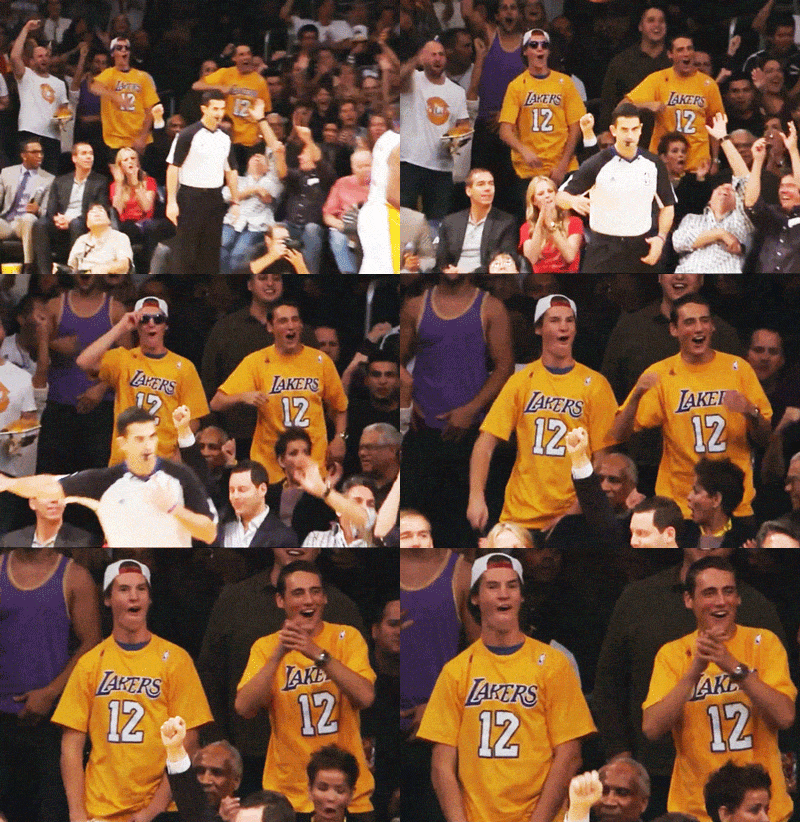
Throughout my reading of Kress, I kept thinking of gifs, probably because I find them most entertaining. But it's interesting to me that they are often scenes taken from movies/tv shows that are stripped of their original framing and several modes. Through motion and gesture, and through my textual framing, these gifs take on a truly new and unique meaning and make new links between the theoretical concepts I've explored here and pop culture, but are still reliant on your understanding of the images presented and the appropriateness of the genre (I'll let you decide how appropriate they are...).
The Politics of Communication
One of the things that I really liked about Multimodality was that Kress talks about meaning being made through the interplay of the author and interpreter. (I'm having trouble remembering back to the beginning of the semester, but...) It seems like most of our readings have given the agency to the interpreter when it comes to meaning making. While I agree that, especially with visuals, the scales would be tipped toward the interpreter, I liked that Kress gave a "shout out" to the author. Without the author's socially-informed manipulation of his/her available modes, the interpreter would be able to exercise his/her socially-informed making of meaning.
More than Kress' author/interpreter interplay though, I liked his idea of affordances. Before reading Kress (who I first read a couple of years ago), I had never really thought about affordances. I'm sure I had thought about things that could be done through text that couldn't be done through visuals—and vice versa—but I hadn't thought about each mode having their own sets of advantages and disadvantages. I like that thinking about the affordances of different modes establishes a kind equilibrium among them. It seems like many people (outside the fields of semiotics and rhet/comp), want to establish some kind of universal/static hierarchy of modes, but thinking about affordances allows us to say "X mode is good in this situation, while Y mode is good in that situation.
Outside of the theoretical aspects of Kress, I both liked and disliked his multitude of examples. In many cases I was glad that he was making sure that I/we understood what he was talking about, but there were other times when I was like "Gunther, I get it! Give me a break with these examples."
More than Kress' author/interpreter interplay though, I liked his idea of affordances. Before reading Kress (who I first read a couple of years ago), I had never really thought about affordances. I'm sure I had thought about things that could be done through text that couldn't be done through visuals—and vice versa—but I hadn't thought about each mode having their own sets of advantages and disadvantages. I like that thinking about the affordances of different modes establishes a kind equilibrium among them. It seems like many people (outside the fields of semiotics and rhet/comp), want to establish some kind of universal/static hierarchy of modes, but thinking about affordances allows us to say "X mode is good in this situation, while Y mode is good in that situation.
Outside of the theoretical aspects of Kress, I both liked and disliked his multitude of examples. In many cases I was glad that he was making sure that I/we understood what he was talking about, but there were other times when I was like "Gunther, I get it! Give me a break with these examples."
Visual Experts
I know a few people have questioned Kress' use of examples from children, but I think they're important to demonstrate our development of (a certain kind of) visual literacy--Kress seems to struggle with the word itself and what kind of meanings it implies, but finds use in it for a term of understanding. So, I would say that Kress raises, for me, questions about visual literacy--especially a model for a development of a visual literacy (which, as he says, is culturally bound). I think one thing that is often overlooked in our class is that people are visually literate for the most part. Since the days of stain glass windows in cathedrals telling stories for the "illiterate" (in terms of reading and writing), mankind has been able to "read" visuals. We're all visual experts but most of us lack the ability to articulate how we are visually literate. Kress, I feel, understands this; he uses examples from children to show how a child--who may be presumably illiterate or yet-to-be-fully-developed--organizes their visual experiences. What are the things that catch the attention or interests of an individual and how does that shape how that image's meaning is processed? By understanding how humans become visually literate, a theory for visual rhetoric can be born.
This is where--I feel--rhetoric and literacy collide. To make an effective visual--in terms of the success of its portrayal of an idea or concept--there needs to be a degree of understanding about the context your working within. I think this might tie into his idea of "framing" but I really have no idea. Every item is processed within a frame of that individual; the individuals' experiences are shaped by the communities that individual has participated within. The individual's interests shape which aspects to pay attention to--responses to prompts demonstrate our interests which, in essence, demonstrate what kind of person we are.
Who knows if Kress would agree with any of this, but these were the kind of questions I had throughout reading him. Where does literacy and rhetoric collide? How is visual literacy developed? What is "visual literacy" for Kress, anyway? Things like that.
This is where--I feel--rhetoric and literacy collide. To make an effective visual--in terms of the success of its portrayal of an idea or concept--there needs to be a degree of understanding about the context your working within. I think this might tie into his idea of "framing" but I really have no idea. Every item is processed within a frame of that individual; the individuals' experiences are shaped by the communities that individual has participated within. The individual's interests shape which aspects to pay attention to--responses to prompts demonstrate our interests which, in essence, demonstrate what kind of person we are.
Who knows if Kress would agree with any of this, but these were the kind of questions I had throughout reading him. Where does literacy and rhetoric collide? How is visual literacy developed? What is "visual literacy" for Kress, anyway? Things like that.
Reframing Kress, and an Aside About Critique/Design
I wanted to talk about frame, but Jacob beat me to it. I am going to talk about frame anyway.
Kress's idea of framing is one of the things that really jumped out at me in this reading. I think his explanation of sentence punctuation as framing was really helpful, and I began to think of framing as delineations in discourse. Sentences need frames for coherence (I'm dating myself here, but I remember reading Indigo Girls lyrics in high school. They would provide liner notes, song lyrics with no line breaks, no punctuation. Just big undifferentiated blocks of text, like Greek writing. The effect was fascinating; I tried to duplicate it in my high school and early college efforts).

So frame helps us break modes into manageable pieces. It says "for our purposes, here is the beginning, and here is the end," though we know that discourse does not begin or end in frames. We frame our writing with paper or screens. We frame speech with silence.
But "without frame no meaning?" I don't know. Maybe the deal is that we cannot help but frame discourse. What, indeed, would unframed discourse look like? I'm trying to imagine. It would be a perpetual motion machine.
I also really like Kress's discussion of design and critique. I'm thinking, especially, about p. 133, where he wrote, "When critique replaced convention, composition became problematic." Shebam!! Has a defter summary of the field ever been composed? Perhaps this one, same page: "Yet critique can work only in relation to stable structures and environments; its task is to bring these into crisis." I think his temporal positioning of design and critique is effective: critique is backward-looking, design is forward-looking. The field exists, I assume, in the kairotic moments that make both possible.
Kress's idea of framing is one of the things that really jumped out at me in this reading. I think his explanation of sentence punctuation as framing was really helpful, and I began to think of framing as delineations in discourse. Sentences need frames for coherence (I'm dating myself here, but I remember reading Indigo Girls lyrics in high school. They would provide liner notes, song lyrics with no line breaks, no punctuation. Just big undifferentiated blocks of text, like Greek writing. The effect was fascinating; I tried to duplicate it in my high school and early college efforts).

So frame helps us break modes into manageable pieces. It says "for our purposes, here is the beginning, and here is the end," though we know that discourse does not begin or end in frames. We frame our writing with paper or screens. We frame speech with silence.
But "without frame no meaning?" I don't know. Maybe the deal is that we cannot help but frame discourse. What, indeed, would unframed discourse look like? I'm trying to imagine. It would be a perpetual motion machine.
I also really like Kress's discussion of design and critique. I'm thinking, especially, about p. 133, where he wrote, "When critique replaced convention, composition became problematic." Shebam!! Has a defter summary of the field ever been composed? Perhaps this one, same page: "Yet critique can work only in relation to stable structures and environments; its task is to bring these into crisis." I think his temporal positioning of design and critique is effective: critique is backward-looking, design is forward-looking. The field exists, I assume, in the kairotic moments that make both possible.
Monday, November 26, 2012
Visual Rhetoric as Meaning-Making
Kress pays close attention to meaning in Multimodality and is able to find meaning in visuals that seem pretty mundane and everyday, perhaps vernacular. By breaking down the modes used in constructing meaning, Kress points out that all choices used in communicating and meaning-making realize social relations, and in effect project and construct social relations. Signs used in communication are socially motivated, and every choice is shaped by power. The semiotic work done by the affordances of modes is also specific to each culture.
So what does meaning making have to do with visual rhetoric? Kress defines rhetoric as the politics of communication. According to Kress, representation gives material realization to one's meanings about the world. Communication makes this representation available to others. Design is the material projection of meaning. Rhetoric deals with the social and political aspects of communication, and at the heart of communication is meaning-making. So, meaning-making is at the core of rhetoric I assume. Much of Kress's theorizing follows an A+B=C which leads to D sort of approach. I'm not sure if I got all the letters in order, but I think some important ones are there.
After reading Christine's response, I thought it was interesting that she saw Kress giving so much agency to the audience. I felt like he was giving a lot of agency to the rhetor/author/creator, while simultaneously giving agency to the audience. It seemed like the rhetor/author/creator makes choices for communication based on social factors, and the way the audience interprets the communication projects these social factors. Agency over communication and interpretation appeared to be sort of cyclical to me.
On a side note, something that caught my attention in the book was Kress's use of studies based on children. Children's drawings in particular make up several of his examples. With all of his focus on power, politics, and social relations, it seems interesting that Kress would focus so much attention on children who seemingly do not have much power in society.
Subscribe to:
Comments (Atom)